Modernising a paint system – safely: What paint shops need to know about CE conformity when retrofitting
New controls, more powerful drives, more automation: When a conversion of an existing system triggers a new legal assessment – and how paint shops can avoid liability risks from the outset.
Anyone operating a spray booth, a dryer or a complete coating line today faces a familiar calculation: A new system is expensive, the existing one runs reliably and is precisely tuned to your parts and processes. Especially in economically challenging times, more and more paint shops are therefore opting for retrofit instead of new investment. But every intervention in the system raises a question that is often asked too late: What does the conversion mean for CE conformity?
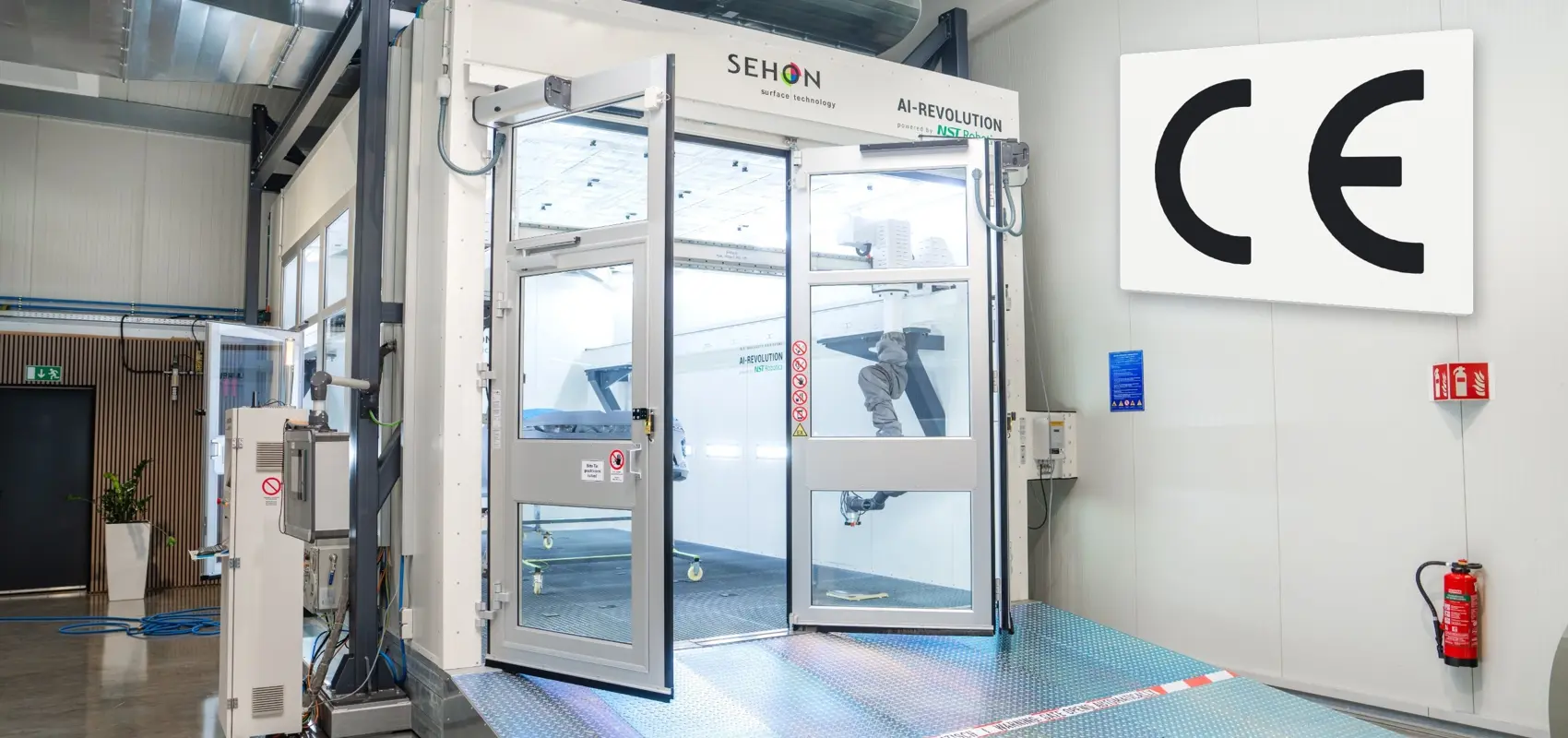
CE conformity: With SEHON, you are always on the safe side for new builds, conversions, modernisation, retrofit or robot integration.
Retrofit as a cost-effective alternative
Many paint shops therefore do not replace their existing system completely, but upgrade where it pays off. Typical projects include more efficient fans and motors, modern system controls, improved supply and exhaust air routing, or adaptations for new component geometries, paint systems and production volumes.
However, each of these measures also has a second side: It can affect the system’s safety concept – and therefore its CE status. Legislators distinguish between ordinary changes and what is known as a “substantial modification”. If the latter applies, the risk assessment must be redone. Regardless, the following applies: Without proper documentation, legally compliant operation is not possible; it is a legal requirement.
Existing systems are not automatically subject to CE marking
First, reassurance for operators: If a system was properly used before today’s CE requirements came into force, it does not need a CE marking retroactively simply because it has aged. The year of manufacture is irrelevant. The only decisive factor is whether an intervention makes a new legal assessment necessary.
However, this does not release the paint shop from responsibility. Occupational safety law still requires an up-to-date risk assessment, safe work equipment and recurring inspections. So even without a new CE procedure, responsibility for the system remains with the operator.
When a conversion becomes a substantial modification
Before a retrofit starts, a clear classification is therefore worthwhile. The key question is: Does the conversion introduce hazards that did not exist before, or do existing risks increase? In painting practice, the following cases may be relevant, for example:
- new controls that implement safety functions differently than before
- faster conveyor technology or greater movement forces
- more powerful motors, fans or burners
- heavier workpieces, for example due to higher load capacities on conveyors
- new or changed operating modes such as fully or semi-automatic operation
- more automation, for example through painting robots
- integration with upstream or downstream systems – here it must be clarified whether an overall machine is created
- switching to different paints or coating materials
Conversely, not every intervention triggers a reassessment. Replacing a defective part with an identical one or performing routine maintenance usually remains within safe limits. The decisive factor is always how the individual measure affects the system’s safety.
From operator to manufacturer
If it turns out that a substantial modification is present, the converted system is legally considered a new machine. For the party responsible for the conversion – often the paint shop itself – this means: It now has the same obligations as a system manufacturer. It must reassess the risks, create technical documentation and operating instructions, meet the essential health and safety requirements of EU machinery law, issue a declaration of conformity and re-affix the CE marking to the system.
For a company whose strength is surface finishing rather than system engineering, this is a considerable effort and a liability risk. That is why the classification belongs at the start of the project, not at acceptance. This saves trouble, rework and unnecessary delays.
Keep the overall system in view
In a paint system, many things are interconnected: booth, ventilation, dryer, conveyor technology and controls form a system. Anyone modernising one area – for example the controls or safety-related control parts – may also change the behaviour of the other components. The same applies when automation technology is added or the system is connected to upstream and downstream machines.
An assessment that looks only at the new component therefore falls short. What matters is what the conversion means for the entire system and its protective devices.
| Topic | Machinery Directive 2006/42/EC | Machinery Regulation (EU) 2023/1230 |
| Legal form | Directive, transposed into national law in each country (in Germany, e.g. the 9th ProdSV) | Regulation, applies directly and uniformly across the EU from 20/01/2027 |
| Conversion of systems | “Substantial modification” described only in guidelines and interpretation papers | Defined in law for the first time: Anyone who substantially modifies a system is deemed the manufacturer – even for software-only changes |
| Cybersecurity | No explicit topic | Controls, software and safety-related parts must be protected against tampering; this is part of the risk assessment and a prerequisite for the CE marking |
| AI and self-learning systems | Not regulated | Safety functions with self-learning behaviour are considered high-risk and require assessment by a notified body |
| Operating instructions | Generally on paper | Digital permitted; at the customer’s request, it must still be supplied in paper form |
Performance Level d: What that means for paint systems
The standard EN 16985 for spray booths specifies how a paint system must be built for all suppliers. A key point is the reliability of the safety functions – such as monitoring ventilation and extraction or enabling the spray gun. It is measured in the so-called Performance Level (PL) according to EN ISO 13849-1, a scale from a (low) to e (very high). Retrofitted systems that are to receive new overall conformity must also be brought to Performance Level d.
For system engineering, this means: Safety functions generally have to be designed with two channels and self-monitoring so that a single fault does not lead to loss of the protective function. This requires safety controllers and components with proven characteristic values, as well as documented calculation and validation of each safety function. Older controls based on relays or standard PLCs often do not reach this level. Anyone converting an existing system and seeking recertification must therefore usually renew the safety technology fundamentally – and that must be included in planning and budget from the outset.
Special case: painting robots
Retrofitting a painting robot is particularly demanding. The robot typically comes with its own manufacturer documentation, and so does the paint system. However, the combination creates a new overall machine whose safety must be assessed as a whole: protective zones, emergency stop, access to the booth, explosion protection and ventilation monitoring must all fit together. Without this overall assessment, the CE conformity of the system and robot is not assured – and in case of doubt, the operator is obliged as the manufacturer.
On the safe side with SEHON
Paint shops do not have to answer these questions alone. As the manufacturer, SEHON Innovative Lackieranlagen GmbH assumes responsibility for ensuring CE conformity is maintained for new builds, retrofit, modernisation and conversions. For the operator, this means: The system can be modernised and further developed without having to assume the role of manufacturer and bear the associated obligations alone.
SEHON is already thinking ahead today: SEHON already meets the requirements of the new EU Machinery Regulation, which will apply from January 20, 2027. Retrofitting a painting robot is also no problem for SEHON – for the AI-supported robotic painting AI-REVOLUTION as well as for all other retrofits. The paint system and robot are considered together, ensuring overall conformity.
Conclusion: Responsibility instead of formalism
For existing systems, CE conformity is not a bureaucratic end in itself. It is about responsibility for people and operations. An older paint system does not need a new CE marking just because it has been running for a long time. However, a retrofit or conversion can completely change the legal situation as soon as new hazards are introduced or existing ones increase. Anyone who clarifies early on how the conversion is to be classified, and substantiates and documents this decision properly, gains legal certainty, reduces liability risks and avoids unpleasant surprises after commissioning. Especially with the new Machinery Regulation, it is worth having a partner who can do both: With a manufacturer like SEHON at your side, CE conformity is assured from the outset – today and from 2027.
|
SELF-CHECK: FIVE QUESTIONS BEFORE THE RETROFIT |
||
|
1. |
Does anything change in the controls, drives or conveyor technology as a result of the conversion? |
☐ Yes ☐ No |
|
2. |
Are different paints, higher throughput or new operating modes planned? |
☐ Yes ☐ No |
|
3. |
Will the system be connected to other systems, automated, or will a painting robot be installed? |
☐ Yes ☐ No |
|
4. |
Is it still unclear whether the conversion will be classified as a substantial modification? |
☐ Yes ☐ No |
|
5. |
Is it still unclear who will assume the manufacturer obligations? |
☐ Yes ☐ No |
|
At least one Yes? Then the CE question should be clarified before the project starts – SEHON will support you. |
||
New construction, conversion or modernization of your body and paint store
Innovation instead of imitation. – High-tech, quality and individuality from SEHON